
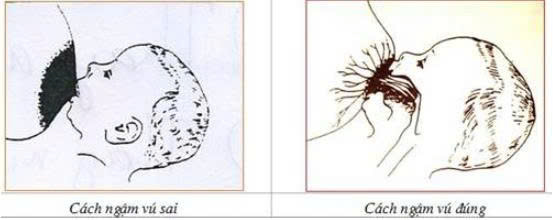
BREASTFEEDING GUIDE
Exclusive breastfeeding for the first 6 months means only breastfeeding without giving the baby any other food or drink, including boiled water, except in cases where it is necessary to take vitamin, mineral or medication supplements as prescribed by a doctor..
Problem statement
Breast milk is the best and most essential food for newborns. Breastfeeding is a natural, economical and effective way to protect the health of mothers and children.
Exclusive breastfeeding (ECB) for the first 6 months means giving the baby only breast milk without giving any other food or drink, including boiled water, except in cases where it is necessary to take vitamin, mineral or medicine supplements as prescribed by a doctor.
Physiology of breast milk secretion
Breast milk production reflex
Milk ejection reflex (Prolactin reflex): When the baby sucks the breast, it stimulates the secretion of Prolactin. Prolactin enters the blood, reaches the breast and makes the breast produce milk, so if the baby sucks a lot, the mother's breast will produce more milk.
Milk ejection reflex (Oxytoxin reflex): When the baby sucks the breast, it stimulates the secretion of oxytoxin. Oxytoxin has the effect of causing the muscle cells around the milk sacs to contract and push the milk out. The Oxytoxin reflex is affected by the mother's thoughts. When the mother has good feelings such as being satisfied with her child, being close to, loving her child, and always believing in breastfeeding, it will stimulate the Oxytoxin reflex.
Inhibition of milk secretion: In breast milk, there is a secondary factor called a milk inhibitor. When a large amount of milk accumulates in the breast, the inhibitor will be secreted, causing the breast to stop producing milk. Therefore, if you want the breast to produce a lot of milk, you must keep the breast empty by breastfeeding frequently or pumping milk.
Types of breast milk
Colostrum
A special type of breast milk, secreted in the first 3 days after birth. Colostrum is thick, pale yellow or clear. Colostrum contains more protein than mature milk. It is very important for babies to be fed colostrum during their first feedings, especially within the first hour after birth. Colostrum is already present in the breast when the baby is born. Do not give your baby any food or drink before he or she starts breastfeeding.
Mature milk
After about 3-4 days, colostrum turns into mature milk. The increased amount of milk makes the mother's breasts full and hard. This is called milk letdown.
First milk
Foremilk is the milk secreted at the beginning of a baby's feeding. It is clear white, abundant, and provides lots of protein, sugar, water, and other nutrients.
Milk at the end of the meal
This is the milk secreted at the end of a baby's feeding. The mother's breasts are no longer full. Hind milk is milky white because it contains more fat than fore milk. Fat provides more energy for the baby, helping the baby grow faster.
Meet energy needs from breast milk:
In the first 6 months after birth, breastfeeding completely meets the nutritional and water needs of the baby.
From 6-12 months of age, breast milk provides 70% of energy needs.
From 1-2 years of age, breast milk provides 30-40% of energy needs.
Benefits of breastfeeding
Benefits for children
A perfect source of nutrition, fully meeting the needs of children in the first 6 months.
Promotes comprehensive development of children. Helps children develop optimal brains.
Prevents infectious diseases, especially diarrhea and respiratory infections.
Breast milk has anti-allergic effects for children
Easy to digest and absorb
Clean, always available and at the right temperature.
Benefits for mothers
Benefits for mothers
Breastfeeding immediately after birth helps expel the placenta, stimulates uterine contractions and reduces the risk of postpartum bleeding for mothers.
Breastfeeding immediately and frequently will stimulate increased milk production and prevent breast engorgement for mothers.
Breastfeeding has high economic benefits (cost savings).
Helps strengthen mother-child relationships.
Reduces the risk of breast cancer and ovarian cancer for mothers
Delayed menstruation and pregnancy help mothers plan their families
Benefits to society
Reduce the risk of disease.
Reduce medical costs.
Principles of breastfeeding
Breastfeed as soon as possible after birth (within the first hour) to stimulate the mother's milk production.
Breastfeed on demand regardless of day or night.
Breastfeed exclusively for the first 6 months, without any other food or drink.
Finish one breast before switching to the other to ensure the baby gets both foremilk and hindmilk.
The average time for each feeding is 15-20 minutes.
Weaning should be done when the baby is 24 months old or later if possible.
When the mother is sick, the baby is sick, or the baby cannot breastfeed on his own, milk should be expressed and fed by spoon.
How to breastfeed
Posture
Depending on the conditions, the mother can breastfeed in a lying or sitting position, but must ensure that both mother and baby are in a comfortable, relaxed position.
The baby's head and body must be in the same straight line.
The baby's belly must be close to the mother's belly.
The baby's face must be turned towards the mother's breast and the baby's nose must be opposite the nipple.
Support the baby's entire body
How to latch on correctly
The areola above the baby's mouth is larger than the areola below.
The baby's mouth is wide open.
The lower lip is turned outward.
The baby's chin is touching the breast.
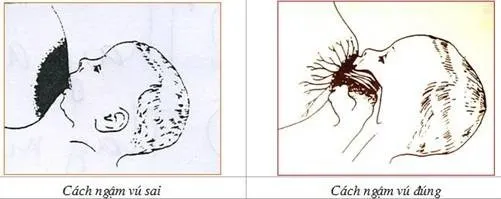
Consequences of incorrect latching
Pain or damage to the nipples (possibly cracked nipples).
Breast engorgement, blocked milk ducts.
The breasts will produce less milk.
The baby will constantly want to breastfeed, cry a lot and each feeding lasts for a long time or refuses to breastfeed.
The baby will gain weight poorly.
Milk
How to express milk: Expressing milk is useful in the following cases:
Relieves engorgement or blocked ducts
Mothers with inverted nipples must express milk to feed their babies while they are learning to breastfeed
Express milk for babies who refuse to breastfeed while they are learning to breastfeed again.
Express milk for sick babies or low birth weight babies when they cannot breastfeed.
Maintain milk production when mothers are away from work or when mothers are sick and cannot breastfeed.
Prevent cracked or sore nipples.
Hand milking technique: (should let the mother do it herself)
Wash your hands
Sit or stand comfortably and hold a cup of milk near your breast
Place your thumb above the areola and nipple, your index finger below the areola and nipple opposite your thumb, with your other fingers supporting your breast, gently press your thumb and index finger inwards and into your chest wall. Do not press too hard as this may block the milk ducts. Press in and out, repeat several times. This should not hurt, if it does, it means you are doing it wrong. Rotate your fingers into the areola on the side to ensure that the milk is expressed from all the milk compartments.
Avoid massaging or sliding your fingers along the skin, avoid pressing on the nipple as pressing or pulling on the nipple will not cause the milk to flow.
Express each breast for at least 3-5 minutes until the flow slows down, then switch to the other side and then express again on both sides
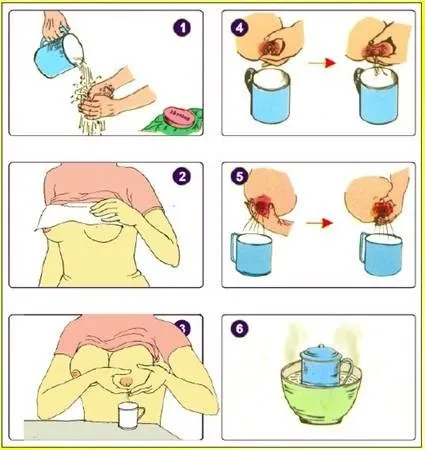 How to express milk
Difficulties in breastfeeding
Insufficient milk: To produce a lot of milk, mothers need to breastfeed their babies soon after birth, breastfeed many times, and breastfeed properly to stimulate the milk secretion and milk ejection reflex. Breastfeeding more at night is also a way to increase milk production. If the mother has to go to work and does not have the conditions to breastfeed regularly, the mother must express milk regularly to stimulate the breasts to produce milk.
Cracked nipples: Usually caused by the baby latching on incorrectly. If the baby latches on incorrectly, the baby will pull the nipple in and push it out while sucking, and at the same time rub the skin of the nipple on the baby's mouth. This causes the mother a lot of pain. After many times of breastfeeding like this, the skin on the nipple will be damaged, causing cracked nipples. Treatment by performing the correct latch will reduce the pain.
Breast engorgement: Causes: Do not let the baby latch on early, breastfeed frequently, latch on incorrectly, limit the time of each feeding. Prevention by letting the baby latch on early, breastfeed frequently and help the baby latch on correctly. Treatment: If the baby can breastfeed, breastfeed regularly. If the baby cannot breastfeed, milk must be expressed by hand or by using a breast pump. Before breastfeeding, use a warm compress on the breast. After breastfeeding, use a cold compress to reduce swelling.
Blocked milk ducts and mastitis: When the milk ducts are blocked, milk stagnates, causing mastitis, which can range from non-infectious to infectious. Treatment: First, improve the circulation in the milk ducts, then find the cause to resolve it. If after 24 hours the symptoms do not improve, further treatment with antibiotics, pain relievers and complete rest is required.
Flat and inverted nipples: Treatment before normal delivery is of no value. Immediately after birth, the mother must be helped to believe that the baby is feeding from the breast, not from the nipple. Help the mother to latch the baby correctly and try to breastfeed in different positions. Help the mother to lengthen the breasts by using a breast pump to remove the nipple.
Taking care of breast milk supply.
Rest and work regimen for breastfeeding mothers
During breastfeeding, the mother needs more energy to produce milk, time to rest, and moderate work. If she has to work a lot but does not eat enough, the mother will have to use the nutrients stored in the body's tissues to produce milk and exercise; the mother will be malnourished.
Nutrition for breastfeeding mothers
Mothers who eat well will have enough milk and good quality milk for breastfeeding.
Pay attention to eating more nutritious foods such as shrimp, crab, fish, eggs, milk, meat, beans, peanuts, sesame, green vegetables and ripe fruits.
You should eat many meals and eat more than usual.
Drink plenty of water (1.5 to 2 liters/day) because the body needs a lot of water to produce milk.
Do not eat spicy foods (chili, pepper, onion and garlic).
Do not drink alcohol, coffee or smoke.
Only use medication when instructed by a medical professional
After 6 months of natural contraception, women can use a contraceptive method, but should not use oral contraceptives containing Estrogen. Instead, they can use drugs containing Progestogen because they do not affect the milk production process.
SUMMARY: Breast milk is the optimal source of nutrition for babies, breastfeeding is beneficial for both mother and baby. Babies need to be breastfed with colostrum, within the first hour after birth. Babies need to be exclusively breastfed for the first 6 months and continue breastfeeding until 24 months.
#ddavietnam
Nguồn: https://benhviennhitrunguong.gov.vn/
Nguồn: -St-
---------------------------------------
DDA VIETNAM INVESTMENT JOINT STOCK COMPANY
☎️ Hotline: 1800 9070 – 0983 746 986 – 0962 700 060
✉️ Email: [email protected]
📍 TikTok: @dda.vietnam
📍 Website: ddavietnam.vn
📍 Address: No. 8, Chien Thang Residential Group, Ha Dong Ward, Hanoi City